Browsing Category

Trekette

Trekette: Day of the Dove

Klingon Mara

Ah, the American late 1960’s. Such an exciting time, full of conflict, protests for peace, arms races, and liberalizations of sexual mores- I am sorry I missed it, and not just for all the free love, concerts and drugs. It was an especially interesting time for women. We were embracing the power of our miniskirts, only a few years away from the braless 70’s. In pop culture, television was starting to go along with our rising ambitions. Star Trek especially was daring for its time, showing an empowered, intelligent and beautiful woman, Uhura, on the bridge.  However, we women had a long way to go in terms of our social progress being mirrored in pop culture.

As progressive as Star Trek seemed to be, it was still a TV show which was constrained in its futuristic vision of equality by the male-dominated worldview of the time it was aired. Uhura’s mere presence as a smart and much-needed crewperson was a giant leap for womankind. However, for each step forward, Star Trek seemed to take two steps back in their female characters. For a woman to have any power, there was always some mitigating precondition — that she be a brainless Eymorg capable of brainpower only at the consent of long-dead ancestors, for instance, or that she be a sociopathic scorned former lover of Kirk’s, bent on revenge for the wrongs she feels she has been dealt based on her gender, as was the case with Janice Lester.

Rarely does a woman join Uhura in the ranks of females who command respect based on their own qualities. Recently, though, I was re-watching an old TOS episode, and it dawned on me that there is one class of females whose power is rarely questioned- the Klingon female. I say “rarely,” though, because even the first Klingon woman we meet has to play that same tired role- the single-use sex object who inevitably needs saving.

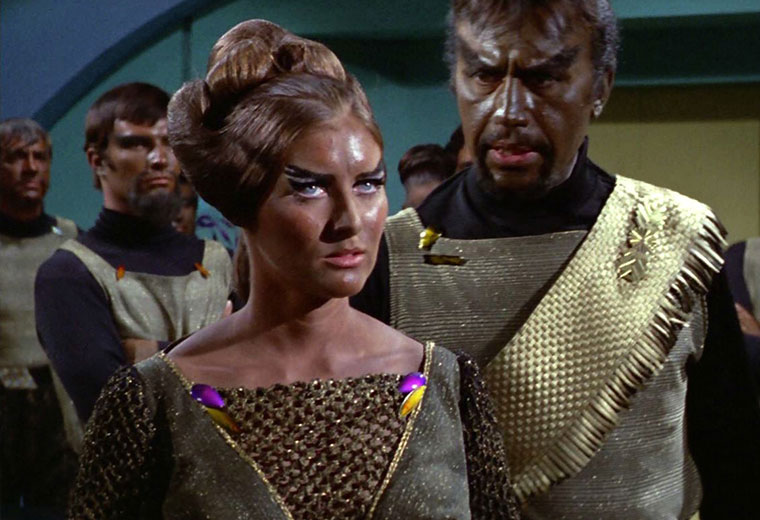
In TOS, we meet the Klingon female for the first time on the episode “Day of the Dove.” Though she is introduced as the wife of the Klingon commanding officer, Mara proves herself to be more than just the captain’s wife. She is also the Klingon science officer, making her their version of Spock. In “Day of the Dove,” Mara, and her intellect, plays a pivotal role in the story. However, she still meets the common fate of many female characters- she is reduced to a helpless damsel in distress, powerless against the atmosphere of male aggression.

When both the Enterprise and the Klingons receive a false distress signal, they quickly become locked into an escalating conflict on board the Enterprise. Strange and impossible things are happening, as improbable events occur which place the Klingons and the crew at equal numbers, the better to fight each other. Hostilities are at such a level that the crew barely seems to notice how odd it is that their entire armory has been converted from phasers into antique swords. Testosterone is running high, clouding the senses of the crew. Especially affected is Ensign Chekov, who has some great lines- I especially enjoyed the creative use of the word “Cossacks!”

Chekov spends the entire episode in a state of heightened rage. Of course, we eventually learn that this is as a result of an evil energy cloud which feeds on aggression. This leads the crew to hack senselessly at their evenly matched Klingon enemies. However, no matter how many wounds are inflicted, no permanent damage is done to a single crew member. Sickbay is crowded with security officers, whose wounds heal rapidly, allowing the carnage to continue. Though the fighting is continuous, only one character is faced with aggression which could have left any permanent damage- Mara, the Klingon science officer. When the enraged Chekov comes across Mara, his lust for blood devolves into simple lust, and he rips at her blouse with one obvious intention. Unlike the female warriors we come to see in later incarnations of the Klingon woman, Mara seems to shrink away from this attempt, barely even struggling against Chekov, and has to have Kirk save the day for her.

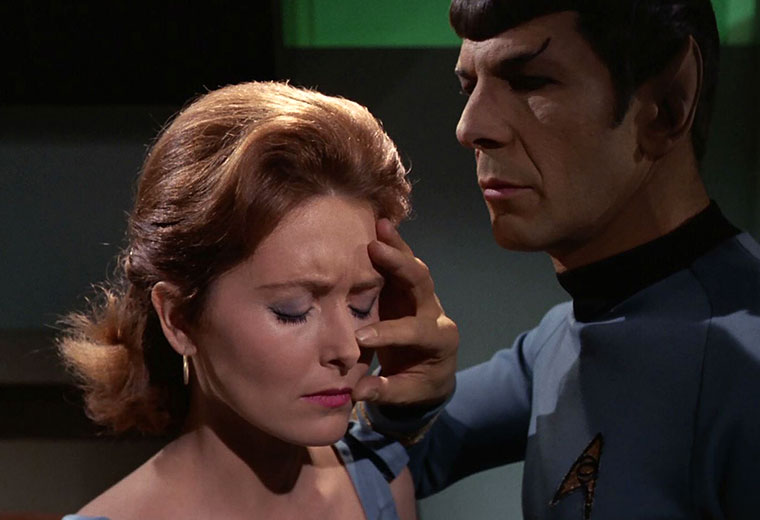
MaraIn light of what we come to know about the Klingon woman later on in other incarnations of Star Trek, the treatment of Mara is especially unlikely. It just goes to show what audiences expected at the time- even a strong and smart female like Mara could be easily diminished. Sure, she gets to be an educated and intelligent member of her ship’s crew, and she gets to wear shorts instead of a dress, but she couldn’t possibly have enough presence of mind to fight back against even attempted rape without a man’s help. I mean, even Janice, helpless stereotypical female extraordinaire, thought to scratch that bad boy up during her brush with male aggression!

Happily, as the Star Trek universe developed, the roles of women became less and less shallow. The next time we meet a female Klingon, we find that she is no shrinking female. Instead, a new class of badass women warriors rise to the challenge of overshadowing their predecessor, Mara. So, here’s to those women, characters created out of a time more advanced in terms of roles for women than the 60’s era Star Trek. I know who I’d rather be!

Trekette OUT!

 
“Trekette” is an ongoing series by Victoria Wright looking at Star Trek through a female perspective.

Trekette: What (Some) Women Want

Scotty and Palamas

What do women want? It is a question which has inspired endless human art and literature. The original series of Star Trek, however, seems to have the answer. Women want an alpha male to tell them that they’re PRETTY!

Ah, our ultimate goal.

Of course, this is not always true- after all, most girls do go for Kirk, but Spock, Chekov, and even our favorite old country doctor get some love interest action throughout the original series. Generally, though, the Star Trek: TOS love interest subplots tend to follow this or a couple other predictable patterns. This stereotype is featured in many episodes, including “Space Seed,” in which a highly educated, intelligent officer allows herself to be completely subjugated by the powerful genetic monstrosity that is Khan Noonien Singh, forgetting all of her training and loyalties in her desperate need to look soft and womanly to her new love interest. And who could forget Yeoman Janice Rand, feverishly hoping that Captain Kirk will just ‘look at my legs!” In another episode, Yeoman Rand isn’t fazed even by attempted rape; she actually says that she wouldn’t have told anyone because she did not want to get Kirk into trouble.

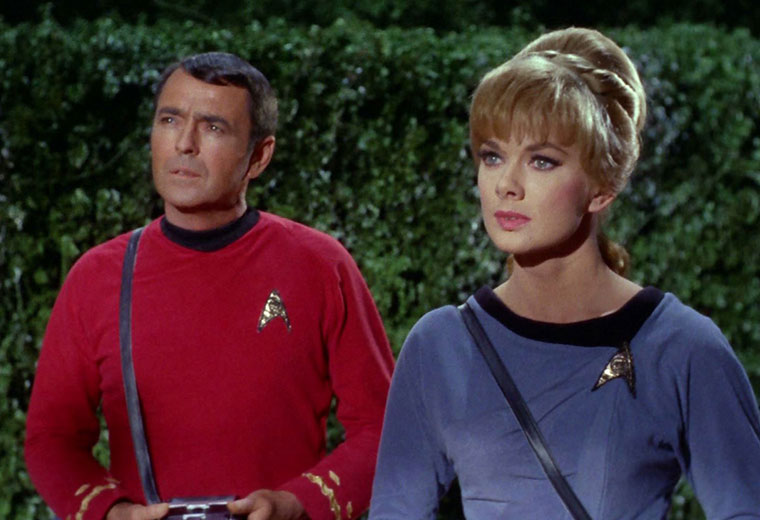
Even Starfleet scientists feel this hunger. Just look at Lieutenant Carolyn Palamas of the episode “Who Mourns For Adonais?” In this episode, Lt. Palamas, archeology and ancient civilizations expert, beams down with Kirk, Chekov, Scotty and Bones to advise the captain in his mission to free the ship and crew from the alien entity once known on earth as Apollo. Apollo has taken the ship captive with a massive, hand-shaped field of energy, one of the godlike powers he possesses. Apollo means to hold the crew on the surface to provide the worshipping masses that sustain his life. Once she meets this Olympian alpha male, however, Carolyn simply melts under Apollo’s constant lavish praise of her beauty. When Apollo uses the same power source which holds the Enterprise hostage to dress her up in a pretty pink gown, she gushes happily, eyelashes fluttering, at its Grecian loveliness. I guess that all it really takes is a cute new outfit and a man of power to crush on and all of our advanced training simply disappears!

Carolyn PalamasMr. Scott, meanwhile, has been pining after Carolyn the entire episode, much to Kirk and Bones’ amusement. Mr. Scott manages to get himself hurt several times in this episode by committing unwanted gestures of male bravado in Carolyn’s honor, which she is too dazzled to notice. Maybe Scotty should have taken a cue from Apollo- the way to a gal’s heart is to say she’s beautiful, not tell her she looks tired, and should join you for a cup of coffee. Thanks a lot, Scotty! I guess it just wasn’t meant to be. As Bones dryly notes, “he thinks he’s the right man for her, but I’m not sure she thinks he’s the right man. On the other hand, she’s a woman. All woman. One day she’ll find the right man and off she’ll go, out of the service.”

I’m not even sure if I’m offended by that quote because it’s NOT true of women, or because it IS true- of this particular character, anyway. Unfortunately for the rest of us strong Star Trek females (not you, Janice), Carolyn Palamas is the epitome of a weak, fluttery, vain female, needing love to survive just as much as the lonely and temperamental Apollo. Carolyn is yet another single-serving love interest for the men of the episode- someone to ogle at and provide convenient plot twists. Carolyn’s historical expertise (“I’m a scientist!”) is a mere footnote to her real purpose- to give the men something to fight for possession of. Her character only serves as a love interest, and her knowledge of ancient history is mentioned merely as an aside in her rejection of Apollo. Asserting that he is merely a specimen for her examination marks one of the only references made in the episode to the fact that she is, in fact, a person of great knowledge and learning.

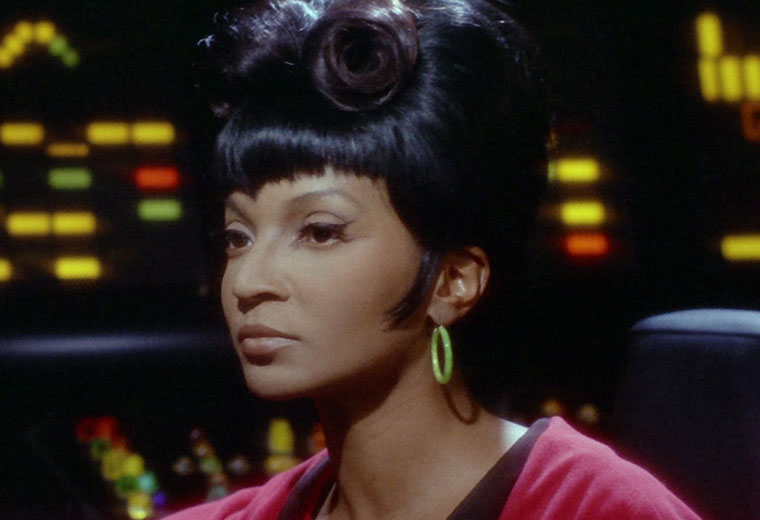
UhuraMeanwhile, on the bridge, Uhura is reworking the entire communications array, aiding Mr. Spock with restoring communication with the away team. Just working away, helping to save the day again so that the Enterprise can continue to boldly go. Does she get any thanks? Nope. But that’s OK! One day, she’ll meet the right man and she can quit the service.

Trekette OUT!

“Trekette” is an ongoing series by Victoria Wright looking at Star Trek through a female perspective.

Trekette: In the Body of a Woman

Turnabout Intruder

In this week’s installment of Trekette, we’re going to take a look at The Original Series episode, “Turnabout Intruder.” The 79th and final episode of the series ventures into new territory: an admission by Kirk of the sexism that Lester had faced in Starfleet Academy. Dr. Lester attributes her sex as the reason for her failed ambition to become a spaceship captain. Kirk even agrees with Lester, who claims, “Your world of spaceship captains doesn’t admit women. It isn’t fair.”

Ah, the plight of women’s equality in the workplace. It’s so unjust to think that a person’s gender, something over which they have no control, could dictate the direction of their career. We are left to assume that there is some kind of glass ceiling which no female could shatter to enter into the ranks of starship captains. However, in this case, Dr. Lester’s gender was not the factor that curbed her ambitions.

Now you know the indignity of being a woman. For you this agony will soon pass, as it has for me. Quiet. Quiet! Believe me, it’s better to be dead than to live alone in the body of a woman. It’s better to be dead.

It is Stardate 5928.2. The Enterprise has sent an away team to the surface of the planet Camus Two in response to a distress call from a group of scientists stationed there to explore ruins of a now-dead civilization. Among those scientists is an old flame of the Captain’s, Dr. Janice Lester, who is one of only two survivors found on the planet. Dr. Lester, the expedition’s leader, is apparently suffering from an ailment which her companion, the expedition’s surgeon Dr. Arthur Coleman, claims is radiation damage. The other members of their company are all dead. As the rest of the away team leaves to search for life signs, Kirk and Lester find themselves alone, discussing the unhappy end of their former relationship.

Dr. Janice Lester has little in common with other females who were single-use, disposable love interests for the captain or other members of the crew. Her status is that of a leader, in charge of a scientific expedition. Clearly, Lester possesses qualities which would qualify her for this in her own right, whereas many other one-episode female characters on the show came into their authority through family connections, or tradition. Nor has her fate descended upon her due to her feminine helplessness, as is common in other female non-recurring characters. Lester is nothing like one of Mudd’s women. For example, her motives are inspired by a desire for power, not a desire to catch herself a husband.

Turnabout IntruderDr. Lester’s failing stems from her pathological need to grasp for more than she rightly qualifies for. Being a leader of a scientific expedition, a position rewarded to her based on her qualifications, is not enough for her- instead, she craves authority which she neither deserves nor has the temperament for. She couldn’t cut it as a candidate for command, but instead of looking to her own deficiencies, she externalizes her failings. Sexism means to be prevented from an equal opportunity based solely on ones gender, despite any skills they might have to make them an equal or better candidate for a position. There are many women who have experienced this, but Dr. Janice Lester is not one of them. Rather than accept that her actions and personality have barred her from the elite order of captains, she indulges in the idea that she has been unfairly dismissed due to her gender.

A starship captain must face his (or her) Kobiashi Maru: accepting that there are “no-win scenarios.” A good captain must have the temperament to move forward in the face of difficulties. You’d never catch Captain Janeway stamping her foot and throwing temper tantrums — this is the very reason that Lester could never have become a captain. Deeply disturbed, hysterical and sadistic, Dr. Lester presents no redeeming qualities which would lend sympathy to her cause. To suggest that her character represents an unfair treatment of women in general would be highly illogical. In this case, the blame which she shifts from her own shortcomings delegitimizes the plight of others who have actually faced sexism.

Dr. Lester, you are making all female Starfleet personnel look bad. Clearly, it is not your sex which caused you to fail in her pursuit of a command- instead, it is your mental instability, your willingness to go to murderous lengths to get your way, which disqualify you. Luckily, Uhura didn’t appear on this last episode- she would have been ashamed on behalf of all female professionals.

So beam me up, Scotty: there are no positive female role models on this episode.

Trekette OUT!

 
“Trekette” is an ongoing series by Victoria Wright looking at Star Trek through a female perspective.

Trekette: That Unit Is A Woman

Uhura

Imagine you’re Uhura, the ultimate Federation female. You’re a Lieutenant of the Federation, smart and confident enough to play with the big boys. You are an integral part of the crew, you speak multiple languages, and you look GOOD. You’re the only woman on the bridge who isn’t there to bring the captain his coffee, but you can still find time to sing a little tune to break up your day. You’re stuck in a skirt so short that you can barely cross your legs without showing some regulation underwear, but your sheer competency earns you the respect of your all-male group of peers.

Usually.

Uhura's skirt

Uhura's infamous skirt

With a career like Uhura’s, I bet you would never imagine that your intellect, your memories, the very things that have made you who you are, could simply be wiped clean. That’s exactly what happens to her, though, in The Original Series’ season 2 episode, The Changeling. In it, an old Earth space probe, Nomad, is found to have “sterilized” the entire population of the Malurians, who had numbered in the billions, while leaving no traces of their civilization behind on the now-uninhabited planet. While searching for traces of the Malurians, the Enterprise is also attacked, leaving its shields decimated.

So, Uhura opens hailing frequencies, and using the translator, Kirk greets the strange entity who has caused so much damage to the ship. Luckily for Kirk, his name sounds so similar to the creator of the entity that the attack is broken off, and the entity is beamed aboard. Once aboard, they learn that the entity is called Nomad. Nomad had been an early probe launched from Earth by his creator, Jackson Roykirk, a famed Earth scientist who dreamed of creating a “perfect thinking machine, capable of independent logic,” according to Spock. Long believed to have been destroyed in a meteor collision, the unit Nomad instead had sustained damages which were repaired through its merging with “the Other,” Tan Ru, originally an alien probe of enormous power intended to sterilize soil samples. When the two merged, Nomad altered his original protocols and became a tool for destruction of any imperfect life forms, which included the entire race of Malurians.

This deadly changeling quickly makes its mark on the Enterprise — seeking to perfect the ships functions, it decides that the efficiency of the vessel could be improved by messing with the engines as well as the crew. At least four unfortunate Red Shirts have to die while Nomad methodically investigates the ship’s imperfections. Among these imperfections are Scotty, who makes the mistake of touching Nomad’s screens in an attempt to get him away from Uhura. Uhura, guilty only of singing on the job, has her mind wiped by Nomad because it determines her to be “defective.”

This is where it starts to get me. Scotty is quickly brought back to life by Nomad under orders of his “creator,” but Uhura’s memory has been wiped, and Nomad is unable to restore it. While much is made of Scotty’s temporary condition, Uhura is left under the care of Nurse Chapel. I guess that the crew isn’t too concerned with having yet another brainless female around.

Nurse Chapel

Nurse Chapel

Poor Nurse Chapel. First she has to put up with the death of a crewman, and then see the crewman suddenly reanimated, but instead of putting her medical knowledge to use by studying the phenomenon with Bones, she gets the lovely task of reeducating Uhura. “See… see spot… see spot r-r-r-run!” Gee, I guess it’s a good thing that Uhura retained her knowledge of both English and Swahili- one can’t expect Nurse Chapel to do everything. We are left to assume that Uhura is able to regain all of what she has lost- who needs childhood memories anyway? However, this is never clarified, and during her absence, another nameless woman in a short skirt takes her post. Kirk is assured that Uhura will be “back on the job within a week.”

A week? One week to relearn an entire lifetime of the skills and knowledge it would take to become the communications officer aboard a Constitution-Class starship? Wow. Now, imagine if roles were reversed and Scotty had had his mind erased. I imagine it would take years to relearn his vast skills and knowledge — but Uhura gets a WEEK and she isn’t even provided with a real teacher. Instead, that traditionally female role is foisted upon Nurse Chapel, whose skills no doubt would be of better use in her FIELD.

Of course, to the unfortunate plight of these ever-ready females, the episode never returns. So, however ill-used, Lieutenant Uhura and Nurse Chapel will be back in the next episode, ready to take on whatever unfortunate fate that is too lenient to befall a Red Shirt, but too harsh to befall a REAL crewperson — a crewman.

Thanks, ladies! Trekette OUT!

 
“Trekette” is an ongoing series by Victoria Wright looking at Star Trek through a female perspective.

Trekette: Brain and brain! What is brain?!

Spock's Brain – Kara

Meet Kara. She is an Eymorg from a glaciated Class M planet in the Sigma Draconis system, and the star of the episode Spock’s Brain. Luckily, she lives beneath the surface of the ice-aged planet, enabling her to wear a backless minidress and gartered thigh-high boots. To the men of her species- Morgs- Kara is one of the “Others,” or a “Giver of Pain and Delight.” She comes with a handy bracelet which she can use to inflict pain by pressing a button, enabling her to control and enslave the males of her species.

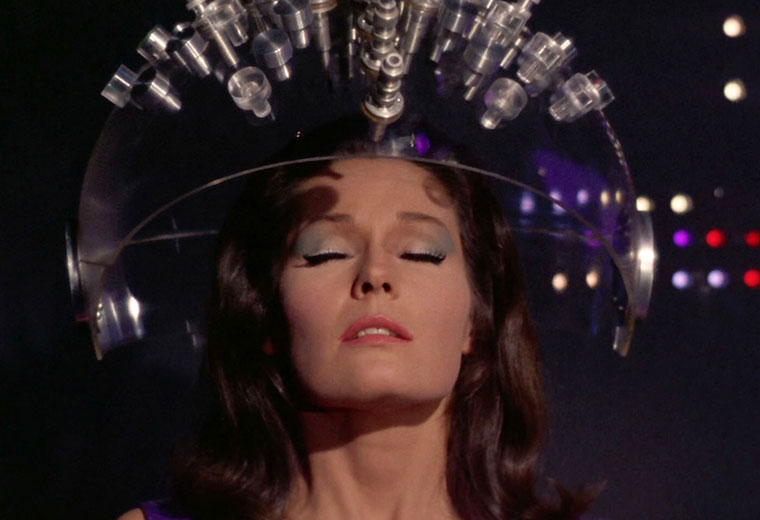
Oh, and she needs a brain, because their underground complex certainly cannot function without their “controller.” Painted into a corner, Kara does what all brainless, helpless females would do if they were in her shoes and shiny purple thigh-highs. I mean – she gets in her spaceship and finds herself a man! First, however, she has to put her thinking cap on. Yes, there literally is a thinking cap. It’s called the “Great Teacher.” The Great Teacher was left by the Eymorg’s highly advanced ancestors, the builders, who intended the Eymorgs to only use it at predetermined intervals. After all, they couldn’t have Eymorgs getting any book learning, could they?

Spock's Brain

Kara steals Spock's brain

So, every few thousand years, the priestess of the Eymorgs, in this case Kara, dons the Great Teacher and departs with enough knowledge to run a spaceship, locate a nice Science Officer, and surgically remove his brain. Three hours later, the knowledge simply wears off like cheap lipstick, leaving Kara a mere brainless Eymorg again. It seems strange to me that such advanced ancestors decided to leave the females of the species with nothing but high-tech bracelets allowing them to enslave the Morgs and a series of color-coded identical outfits. Apparently the only skills and knowledge the Eymores are able to retain are makeup application and filling caves with food to lure the Morgs into servitude. Well, there is that saying about the fastest way into a man’s heart… unless you have a pain bracelet!

This is one of the few episodes of the Original Series in which the acting outshines the plotline. McCoy especially has some great lines in this episode- I personally enjoyed his “Jim, it’s no use. You’ll get nothing out of that one. Hers is the mind of a child.” Gee, thanks, Bones! In Kara’s defense, I don’t think that any of the Morgs would have been a better conversationalist.

Apparently, Kara’s planet was once extraordinarily advanced, but fell into an ice age which forced them to build an underground complex for the women of their species to take shelter in while the men toiled on the planet’s surface. Centuries later, Morgs lived on the frozen surface with no female presence, took no mates and knew nothing of the other gender except that they were the “givers of pain and delight.”

Spock's Brain

This really makes me wonder how the species continued to propagate. Obviously there was some breeding going on to keep the species alive, if sufficient generations had passed that each gender forgot its traditional role and the brains of the species were able to atrophy from long disuse. So, was there a class of breeder-Morgs tempted out of their frozen Eden by evil, witless females wearing magic pain bracelets? Since the Morg that Kirk and the rest of the away team spoke to seemed so horrified at the thought of anyone actually seeking an audience with the Eymorgs, I can only assume there was no foreplay button on those gold bracelets. Then, after the “delightful aspects” are done with, the Morgs are forced into servitude. by the magnetic belts they wear which can be used to inflict pain by a simple press of a button on an Eymorg’s wrist.

Naturally, before the hour is up, Spock’s brain is recovered, and we can all rest easily knowing another episode is ending with the sounds of hearty, fake Kirk laughter.

But what is to become of Kara and the Eymorgs?

Well, apparently the Prime Directive does not apply to cultures run by witless females, especially when the Enterprise’s First Officer’s brain is involved. Since the Eymorgs needed Spock’s brain to keep their habitat functioning, I suppose that upon the away team’s departure they simply starved and went without life support systems until Starfleet got there to liberate them. As Kirk assured a panicked Kara- “You’ll be fine!” After all, the Morgs and the Eymorgs can “control together.”

KARA: We will die.

KIRK: No, you’ll live and develop as you should have. All this shouldn’t have been done for you. Now the women here below and the men here above will control together.

KARA: They will not help us without the pain.

KIRK: There are other ways. You’ll discover them. You must move to the surface, you understand.

KARA: We will die above in the cold.

KIRK: No, you won’t. You’ll learn to build houses, to keep warm, to work. We’ll help you for a while. Humans have survived under worse conditions. It’s a matter of evolution. You’ll be fine.

And that’s all, folks! Another new life and new civilization sought out. I just hope they got more Starfleet assistance than the Botany Bay crew!

Trekette Out!

 
“Trekette” is an ongoing series by Victoria Wright looking at Star Trek through a female perspective.

Trekette: An Ongoing Look at Star Trek Through Female Eyes

Trekette

Computer! Hello, Computer!

Ah, well, born in the lousy 20th century, I have to use a keyboard- how quaint!- to communicate. Welcome to the first edition of Trekette – An ongoing mission to explore the Star Trek universe for positive female role models!

Now, I am not the world’s biggest feminist. Personally, I enjoy the big hair and cat-eye liner, soft pink lighting and skimpy uniforms. I am not here to denounce Star Trek as sexist. However, I think most would agree that at least the Original series lacks female perspective. The show was as sexist as the era it first aired in and the viewers’ expectations it played to. As a result, the most important females of the cast were relegated to traditional roles- a nurse and a glorified secretary. If a female was taken seriously for the skills she brought to an away team in the original series, she would probably end up having to make out with Kirk by the end of the episode. Even Uhura and Nurse Chapel were not immune. Uhura, for instance, did indeed share the first interracial kiss on TV – with Captain Kirk struggling and writhing to get out of performing the kiss at all! Nurse Chapel, demoted from her more serious role in the Menagerie episodes, instead gets to play the nurse overcome by a silly, unreturned passion for Spock. Silly females! This seems to imply. Trying to do men’s work! The ideal female on the show seemed to be Janice Rand- “More coffee, captain?” (Simper! Wiggle! Bat Eyelashes!)

Only in later versions of Star Trek do females start to have more equal opportunities, allowing them to develop real and more nuanced onscreen personalities. It must have comforted Majel to know that her role as a nurse would pave the way for a female doctor on The Next Generation, one who could take command from the big boys in times of crisis- and that she could do it all wearing pants! Meanwhile, Dianna Troy was seated to the left of the Captain, on the bridge, and her counsel was always respected by the commanding officers of the ship. She wore whatever she wanted and always had a kind word, but her empathic abilities made her a force to be reckoned with that had nothing to do with her beauty.

When I was a little girl, I idolized Dianna Troi and Beverly Crusher. My parents, mindful of gender roles, made sure that all of my childhood toys were feminine in nature, and as a result I still fondly remember my Guinan, Crusher and Troi action figures, my Ensign Ro Bajoran earring and my Dr. Crusher tricorder. To my brother went the cooler toys, the phasers and the transporter, the light-up shuttlecraft Galileo. I remember being wildly jealous of his Spock pajamas, begging for a Dianna Troi blue dress.

My grandmother knew how I felt about Troi, and one year she bought me an autographed photo of Troi from a convention. It still hangs on my wall. Dianna seemed to be to be the ultimate woman: beautiful, graceful and above all, respected and confident. Here was no Sleeping Beauty or Ariel waiting for a man’s kiss to make their dreams come true! Troi could do it all and eat her chocolate sundae too. I did not realize it at the time, but the women of Star Trek had a much more profound effect on me than any Disney princess.

From Star Trek I have learned:

… that sometimes you’re just the Yeoman, and your captain is a harassment suit waiting to happen, so make sure to scratch him up good so that you can identify your attacker.

…that empathic tendencies and a friendly smile can neutralize disagreements, even interplanetary ones, faster than any phaser or photon torpedo.

…that it’s OK to indulge in some fudge or a nice Earl Grey as long as you are performing your role competently and fairly.

And most of all… that females are just as capable of making command decisions as males, and they can do it wearing low-cut dresses and heavy makeup with grace and ease. Set phasers to stunning, because we make this look GOOD!

Trekette OUT!

 
“Trekette” is an ongoing series by Victoria Wright looking at Star Trek through a female perspective.