Browsing Category

Strangers of the Cosmos

Strangers of the Cosmos: Bolians

star-trek-bolians

Bolians were primarily featured as minor characters in Deep Space Nine, The Next Generation, and Voyager. Their personae often ranged from cowardly to greedy, and their presence on the show seemed to serve the purpose of offsetting particular tones and moods. Well, the writers may not have done them much justice in the past, but in this installment of Strangers of the Cosmos, I plan to do just that: Give them the respect they deserve—or rather examine their biology a little further, which is more attention than they have gotten before.

Blue Blood and Blue Skin

Let’s start with the obvious details. One doesn’t need to be a biologist to figure out that they have blue skin. Like Andorians, Bolian blood is also blue. Assuming Bolians metabolize and transport oxygen the same way humans do (how else could they breathe in the same atmosphere as us), their oxygen-carrying proteins would utilize metal ions with an affinity to bind oxygen. In humans, hemoglobin uses iron(II) to bind oxygen; in fact, the red color in our blood comes from iron in its +2 oxidation state. In Bolians, the metal that binds oxygen is most likely copper(II) (again, in its +2 oxidation state). Copper(II) appears blue in solution, unlike most other transition metals with varying colors. Of course, skin color is independent of blood; the bluish tint in their skin is primarily due to pigments, the origins of which may be the result of natural selection for some unknown survival benefit. So remember: The color of blood-borne ions does not correlate with skin color; if it did, Vulcans would be green.

The Bolian “Flight or Flight” Mechanism

Don’t be confused by the subject title. I really meant “Flight or Flight” because Bolians seem to do a lot more running away than actual fighting on the show. In fact, Bolians were often presented as being overly cautious and paranoid on Star Trek. In the Deep Space Nine episode “The Adversary” (the season 3 finale) the Bolian security officer was always more jittery and paranoid about the Changeling imposter on the Defiant than everybody else. Though any person would be understandably paranoid if a potentially hostile Changeling was aboard a small ship, the Bolian remained more fearful and irrational than any other member on the Defiant.

Bolian Security Officer

In one scene, he almost shot Captain Sisko and Major Kira out of a sense of self-preservation and fear, as though his discipline as a Starfleet officer were somehow neglected. Another instance was on Empok Nor, where Nog, Miles O’Brien, Garak, and a team of ensigns visit DS9’s sister station to salvage technical parts and components.

When a group of drugged, psychotic Cardassians were let loose in the station to hunt down the intruders, it is the Bolian, among all the others, who prefers to hide rather than go after the assassins. In fact, the Bolian says he would feel a lot safer with Garak on the hunt for the two Cardassians, implying that he would rather have someone else do the fighting for him (and of course Garak was also a highly trained spy and assassin in the Obsidian Order, so that fact more than influenced the Bolian’s decision). Even when other Starfleet officers were willing and able to defend themselves, the Bolian insisted on hiding.

Bolian security officer aboard the USS Defiant; he nearly shoots Captain Sisko and refused to lower his weapon when ordered to do so by two superior officers.

It doesn’t mean Bolians would always run from a fight (they wouldn’t volunteer in Starfleet otherwise), but they seem to be more prone to fear than any other race on Star Trek. This “flight” instinct may have been a crucial part of their evolution. If they evolved on a planet where their species were constantly preyed upon and where a direct confrontation with predators would almost always lead to defeat (as implied on the Deep Space Nine episode “The Magnificent Ferengi” in which it is said that Bolians have always been physically weak), then natural selection would favor the fitness of individuals with a tendency to run and hide for self-preservation.

The fearful, cautious, even paranoid Bolians would naturally avoid danger and survive long enough to have a greater chance to pass on their traits to offspring, while brave Bolians who probably didn’t have the strength to overcome threats to individual survival would likely die out quickly. The early Bolians with the ability to hide better would persist, survive, and reproduce faster than those who chose to fight in unwinnable battles.

A race of cautious, paranoid individuals is the logical outcome of a form of natural selection that favors fear as a means of survival. As such, their natural instinct to hide or run from danger may have influenced their social behaviors, which would explain why they appear to be scared on the shows. Of course it’s difficult to prove that their concept of fear comes from this “flight” mechanism from the standpoint of only a few examples (and in science, it takes A LOT MORE than just two data points to confirm a hypothesis), but this is, after all, only harmless speculation.

The Hairless Phenotype and Reproduction

Members of the Bolian race tend to be completely bald, with the exception for the few females who had hair on The Next Generation. Assuming Bolian genetics is anything like human genetics and that they have gene-carrying chromosomes the same way we do, it can be inferred that the hair/bald phenotype is a sex-linked trait, meaning essentially that the expression of a given trait correlates with gender.

This is not to say, however, that the baldness trait in Bolians is anything like the baldness trait in humans (which is also a sex-linked trait), but rather that the expression of the hair trait may be activated by genes on one (or several) sex chromosome(s). It may be that the expression of the hair trait is activated by a combination of functional genes. If this were the case, then the actual gene that directly produces hair isn’t necessarily in females only; it could also be in men.

One of the abducting aliens on the TNG episode “Allegiance” who took on the appearance and role of a female Bolian with hair; though not actually a Bolian, it can be assumed that females with hair are not uncommon among Bolians as neither Picard nor anyone else found her appearance to be suspicious.

It is really impossible to determine whether the hair phenotype is located on the sex chromosome(s) in Bolians, but certainly the genes that activate hair production is likely located on the sex-chromosome. If anything can be inferred from Star Trek, it’s that Bolian hair could be an ethnic and/or “sexy” trait used as a means to attract the opposite gender, hence the reason why some Bolian females have beautiful, voluptuous hair. For the same reason that large breasts and hourglass hips in human women attract males to potential mothers (large breasts for maximum milk production and a wide pelvic bone to support fetal development), hair may be a sexual indicator of potential mothers in Bolian females. Therefore, the gene that produces hair may be present in all Bolian females but is only activated when a combination of factors are present, such as those that enhance fertility in women.

Mitena Haro

If this were the case, wouldn’t more females have hair because women with hair would probably reproduce and nurture their offspring better than bald women (and that males would prefer to mate with females with hair as opposed to unattractive, bald Bolians)? Instead, we’ve only seen one or two Bolian females on The Next Generation; all the rest were bald. It certainly may be the case that hair is not only a sexual indicator, but perhaps an ethnic trait as well. It’s possible that the Bolian species consists of many different ethnic groups from different regions on their home planet just like humans do. So hair may be apparent in certain ethnic groups where the association between hair and reproductivity was maintained by natural/sexual selection. If early Bolians migrated and diverged from this prime ethnic group and somehow lost that association (i.e. a new location means different selective pressures), then perhaps they also lost the “hair” gene. This would explain why so many Bolians, both male and female, are bald while only a few apparently still have hair.

Tom Caldwell holds a Bachelor’s of Science in biochemistry from UCLA. He is currently working towards a Ph.D. in molecular biology.

Strangers of the Cosmos: Changelings

DS9's Odo

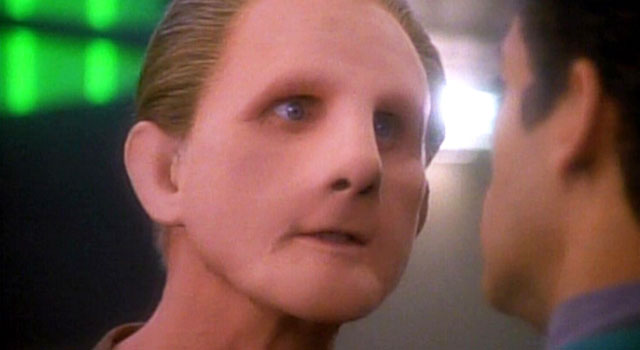
Changelings, also known as the Founders, play an important role in science fiction as deceivers and impersonators. On Star Trek: Deep Space Nine, they are the leaders of the dreaded Dominion, the vast empire that controlled the entire Gamma Quadrant and fought a violent three-year war with the Federation and the Klingon Empire. Their ability to change shape into any object and impersonate any member of society makes them one of the most feared races in the Star Trek Universe.

What physiological processes are involved in shape-shifting? The first thing that comes to mind is differentiation. Cell differentiation is a phenomenon of biology in which cells can replicate and branch out into new types of cells. This is displayed in the remarkable properties of pluripotent stem cells, which not only have the ability differentiate into any cell but they also generate “immortal” cell lines (see my previous Science Fiction or Science Fact article on regenerative medicine for more information). Changelings are probably nothing more than a sophisticated collection of stem cells that forms an even larger network, all communicating and adapting together, generating some form of collective intelligence or self-awareness (i.e. the Great Link).

The Great Link
The Great Link on the Founders’ homeworld

Of course, stem cells really don’t differentiate overnight. It can take several months of rigorous lab work to generate one stem cell line and differentiate it into something new. Furthermore, there are no instances of stem cells differentiating into cells of another species; the ability of Changelings to quickly shape-shift into a Romulan or a human cannot be explained by our current knowledge of stem cell biology, but rather by some other unknown biological process (which may be impossible, in my opinion).

Perhaps the most disturbing notion about Changelings is that the very nature of shape-shifting seems to breach the universal Law of the Conservation of Mass. Mass can neither be destroyed nor created (at least in conventional physics). In accordance to the law, the mass of a Changeling does not change when shape-shifting. Essentially, the bird-form of a shape-shifter would have about as much mass as a 200-pound person. That’s way too heavy for a shape-shifter to fly on Earth!

This always disturbed me because Changelings on the show seem to transform into objects that were easily carried around by individuals without significant exertion. Consider the scene in the DS9 episode, “Homefront”, where Captain Sisko and Vice Admiral Layton walk in with a seemingly light briefcase which turned out to be the shape-shifted form of Odo. How can all the mass of one person be so condensed into the size of a briefcase and not feel quite as heavily? Sisko should’ve been dragging Odo on the ground, using all of his strength and weight to pull him!

Changelings are gelatinous in their native form. Every 16 hours they must revert to this state in order to regenerate from a day’s worth of shape-shifting. This implies, as it should be obvious, that morphing into and maintaining different structures require metabolic energy, and reverting to their gelatinous state “saves” energy.

Odo unable to hold his shape
Odo’s cellular structure destabilizes and turns gelatinous when unable to maintain his form

We still have yet to see a Changeling eat and metabolize food. No organism, no matter what species it is, can survive without sustenance; it is a foundational principle of cell biology. Where and how do the Founders get the energy to survive, let alone shape-shift? They certainly don’t get it while sleeping because sleep does not recuperate energy; it still consumes it, albeit at a lower rate. If rapidly differentiating and mass-altering stem cells don’t bother you, then an organism that can survive without food should! Obviously, they must get it somewhere and somehow.

Other aliens of Star Trek may seem unlikely in terms of biology, but Changelings are certainly one of the least plausible (and most bizarre) races described in the canon. If you can imagine a species that exists as a huge mass of extra-potent, immortal stem cells that can instantly change its own shape and mass and thrive on no metabolism, then you have yourself a Founder! One thing is for certain: there is nothing in conventional biology that could help us rationalize the way Changelings are put together, so I leave it to our greater imagination to find the answers.

 
Tom Caldwell holds a Bachelor’s of Science in biochemistry from UCLA. He is currently working towards a Ph.D. in molecular biology.

Strangers of the Cosmos: Tholians

Tholian

Welcome to the first official installment of “Strangers of the Cosmos,” a new column here on TrekNews.net. Each week we’ll take an in-depth look at an alien race within the Star Trek universe.

The series unofficially debuted as part of my “Science Fiction or Science Fact” column, featuring the biology and evolution of Romulans, Vulcans, Klingons, and Andorians.

In this installment, we will pay close attention to Tholians and how evolution might favor physiological and anatomical qualities that are so unique to this race on the shows.

Mentioned on at least two Star Trek series, Tholians are aliens, whose biochemistries appear to be humanoid in nature, but their carapaces are crystalline and their body plans bear both male and female sex organs. They also thrive under extreme heat and pressure, conditions that would vaporize any human.

In the Star Trek: Enterprise episode, “In a Mirror, Darkly I,” there is indirect evidence that Tholians have a cardiovascular system. The Mirror Universe Phlox synthesized a sedative that rendered a Tholian prisoner unconscious; by understanding how sedatives work on animals, we could speculate how it would work on Tholians and appreciate the complexity of their body systems.

The chemical would have to be administered locally and circulated throughout the body until the central nervous system is affected. On the show, the sedative was released in the holding cells as a gas, which is treated locally by absorption into the bloodstream from the lungs, further implying that Tholians not only have a circulatory system, but perhaps a respiratory one as well. Whether they have an open or closed circulatory system is unknown with the given information.

Tholian

The most interesting feature about Tholian anatomy is the fact that they have both male and female parts, a suggestion that the species is hermaphroditic. Hermaphrodites are not uncommon on Earth and their origins are well explained in context of natural selection. According to the Theory of Sex Allocation (an attempt by science to rationalize the apparent male-to-female sex ratios in a given population), hermaphrodites can have a reproductive advantage in nature if the benefit to their fitness is greater than the resource costs required to maintain both sexual functions (male and female) in the same individual. If it requires more energy to maintain both sexes in each individual with little gain in fitness, then the members of a species could only afford to be distinctly male or female (as is the case in humans) and the hermaphroditic trait is potentially disadvantageous. Sexuality in hermaphrodites (i.e. snails) are so primitive that they require even less energy to maintain both sexual parts with an even greater increase in reproductivity, meaning essentially that every member of a species is reproductively compatible.

Tholians, by implication, may reproduce primitively, requiring only a few resources to support the simplistic male/female traits present in every individual. Their mating may not be any more complex than the way snails reproduce.

Snails Mating
Snails mating

Hermaprhoditism in Tholians also implies, though indirectly, that their evolutionary ancestors lived in a very harsh environment, with limited resources, constantly stalked by predators. It is equally likely that their evolution as a species was influenced by lower population numbers, requiring the emergence of hermaphroditism to counter the threat of extinction. In other words, every member of society would have to be reproductively compatible with one another (even themselves) in order to prevent their own population from dwindling.

It is important to note that, while Tholians evolved to master their own environment and probably no longer need the hermaphroditic trait to survive, it could’ve been maintained after millions of years past its usefulness due to morphological constraints on their body plans: the entire species may have become so dependent on this mode of reproduction that any deviation from it might have promoted lower reproductive success. In other words, they don’t remain hermaphrodites because they need it to survive in their given environment; they remain hermaphrodites simply because the entire race has adapted so well to hermaphroditism that they cannot revert to anything else.

RELATED: Science Fiction or Science Fact: The Strangers of the Cosmos

Tom Caldwell holds a Bachelor’s of Science in biochemistry from UCLA. He is currently working towards a Ph.D. in molecular biology.