Browsing Category

Columns

How Google Goggles & Project Glass Makes Star Trek Technology a Reality

levar-burton-tng

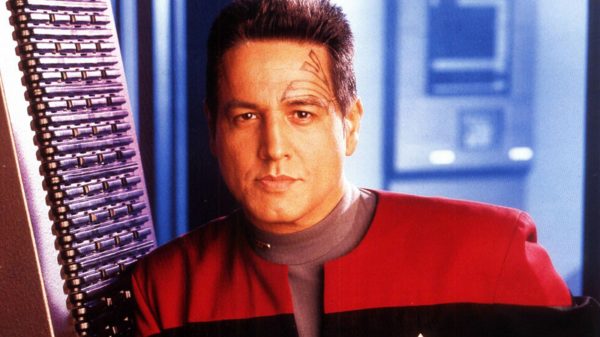
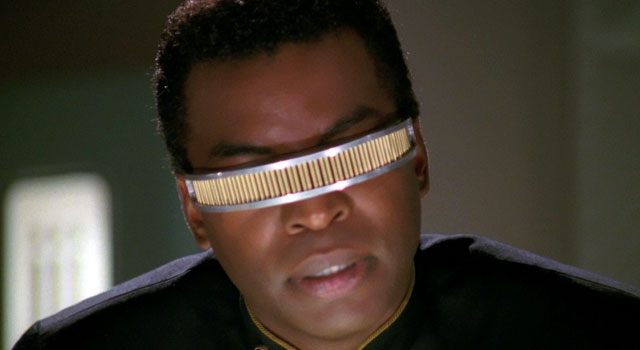
Surely, fans of Star Trek: The Next Generation will remember LeVar Burton’s character, Geordi La Forge, one of the show’s most influential and inspiring characters. A person born with blindness, by today’s standards, would’ve been excluded from so many opportunities due to this crippling disability. In accordance with the humanist themes of Star Trek, it’s more than fitting to imagine an example of a disability today on Earth being surpassed in the future. In fact, it really does stand as a testament of human courage and ingenuity to see someone as brave and capable as Geordi rise to the occasion and overcome adversity, and due in no small part to his VISOR (Visual Instrument and Sensory Organ Replacement).

The VISOR not only allows Geordi to see things when his eyes are unable to, but they can even allow him to analyze his surroundings in wavelengths that are imperceptible to the human eye.

In the season one episode of TNG, “Heart of Glory,” Geordi uplinked his VISOR to a transmitter to allow the bridge crew to see what Geordi saw on an away mission. The images were a spectacular show of bright colors and vibrant hues representative of infrared and ultraviolet sources, such that Captain Picard regarded the display with a single word: “Extraordinary!” It was a scene that roused more envy, awe, and appreciation rather than pity among Geordi’s friends as they saw his blindness as more of a gift than an actual disability, as evident in Picard’s reflection: “Now I’m beginning to understand him [Geordi].” It was a demonstration in Star Trek that proves the best way to learn from others is by putting oneself in another’s shoes to see what he or she sees.

How is Geordi’s VISOR related to Google Goggles and Project Glass and how is it so remarkable? Imagine more than 20 years ago, you saw that episode when it first aired and someone next to you said: “I bet Google is going to come out with a device or an app that allows computers to compile and visualize data from their surroundings and interpret reality in the same way our brains make sense of everything around us. Amazing, huh?” Your first reaction might’ve been: “What’s a Google?” All jokes aside, one might have a negative reaction in the 60s if one’s friend said Star Trek communicators will turn out to be cell phones more than thirty years later, and that the technology would become so advanced that everyone would have them. Why should we expect any less when it comes to Google Goggles? Why shouldn’t we expect this new invention to become the prerequisite design for Geordi’s VISOR?

Google's Project Glass

What are Google Goggles? Google Goggles is the next generation of computer technology. Just as Smart Phones and iOS devices were the next generation advances that combined cell phones and computers, Google Goggles are the next phase in computer technology that allows the user to compile information from a single image or collection of words and phrases. The process is technically a lot more complex that I made it sound. So the best way to explain this is with an analogy.

When you look at an object, your brain analyzes and synthesizes an accurate representation of that object in your mind; it is a way of bringing reality completely within the scope and grasp of your mind. You can look at something as seamless and simple as an apple and understand the concepts of color, taste, texture, and other things just from looking at it and experiencing it (i.e. seeing the apple and relating sight with your other senses). Your brain will compile information from that experience, analyze it, integrate its conceptual domains in your consciousness, and react from it; this information is both useful and necessary for your survival as an autonomous, free-willed individual. You may not notice it, but there is a whole complicated, multifaceted process involved in looking at an image and extracting useful data from it, not unlike the way a computer would analyze a data set to return a logical, mathematical conclusion. Just as a calculator uses a simple algorithm to determine that 1 + 1 is equal to 2, your brain uses a highly advanced algorithm to understand and form concepts from reality. While nature has had millions of years of trial and error to evolve a brain as complex as ours from the bottom-up, it is tremendously more difficult for scientists to work top-down to recreate a brain-like computer that can take a picture of an apple and analyze that image into bits of information and form concepts of taste, color, and texture from the experience. It would be like asking your inanimate digital camera trying to grasp the concept of “food” just from the image of an apple. All a camera could do is take a picture, render that image into bits of digital information, and re-render the info into a visual representation of reality; it can’t analyze or synthesize it beyond that. It can’t tell you how an apple is conceptually related to a human being any more than it can visually take a snapshot of a human being eating an apple; the software of a camera is direct and limited while the software of a human brain is so much more complex.

This is why the Google Goggles is so extraordinary! It is a computer feature that will analyze images taken by a camera phone for key words and phrases. We already have Smart Phone technology that can analyze a barcodes, conceptualize the codes on a very minimalistic level (by minimalistic, I mean preprogrammed), and finally return a webpage linked to the image. What is so remarkable about Google Goggles is that it can do more than just analyze a barcode: it can conceptualize words and search for key phrases on the internet to find even more relevant information. When Smart Phones was limited to a preprogramed software to analyze barcodes, Google Goggles is the next step in computer evolution that can analyze whole words and sentences from a picture. It may not grasp the full meaning of a sentence, but it can at least identify the individual words of a sentence. With object identity (such as distinguishing an apple from a human), the app would have some difficulty, but who’s to say that the current program can’t be improved upon to make that an eventuality?

When before taking a picture with a camera phone revealed nothing more than an image, now Google Goggles can allow one to take a picture of an object to recall more detailed information beyond what is revealed in just the image alone. Of course, it isn’t perfect: there are certain things it can’t do and object recognition is nowhere near as sophisticated as word/phrase identification, but the software can still do amazing things.

The video below explains more about Google Goggles.

Watch the video Google released to hype the development of Project Glass below.

Obviously, if we can design a computer program that analyzes its surroundings for conceptual feedback, then imagine the possibilities for artificial intelligence in the future. This is very much a Science Fact, no doubt, but why the reference to Geordi’s VISOR? How are the two related? Well, the VISOR works in very much the same way: the VISOR picks up visual information from the environment in more wavelengths than the human eye can detect and interpret those signals into a digital format that the brain can understand. In a sense, the VISOR is a piece of technology that is able to conceptualize its environment in a form more accessible to the human brain.

The main differences are (1) Google Goggles are more sophisticated in the sense that the program does the “thinking” for you and (2) the VISOR can pick up wavelengths outside of the visual region of the electromagnetic spectrum. I can see huge potential for Google Goggles as a visual aid for the blind sometime in the future. If a neuroscientist can bypass the eyes and apply visual-sensory input directly to the brain’s analytical regions (also known as association areas), then there is no reason not to expect microcomputers in the future that could potentially alleviate blindness in those that cannot see as well as offer Smart Phone/iPhone users a very interesting and useful app.

Federation Follies: Friendly Fire

federation-follies

Ok. I admit it — It’s been awhile since the last installment of Federation Follies, where I discussed some of my favorite Star Trek episodes to watch around Halloween.

I had a list of excuses as long as my arm ready for the editor here at TrekNews.net. Chief among them: my wife and I had a baby! But I’ve also been working! And Evil Picard turned my desktop computer into a makeshift still! There were LOCUSTS! All true (mostly), but not the real reason I’m been M.I.A.

No, the truth is far more shameful.

I’ve become addicted to Star Trek: Online.

Ever since the game went free-to-play, I’ve been flying around in my wicked starships, chasing Romulans, cheating on Academy exams, and doing my duty rosters. DUTY ROSTERS, PEOPLE. Seriously, forget what you think you know about Star Trek: Duty Rosters are EXTREME TO THE MAX.

After flying solo for a month, I suddenly remembered that this was a multiplayer game. “Sure,” I mused, “I have an elite cadre of computer-controlled officers to assist me, but aren’t there also real people playing this thing?” I opened my eyes to the larger universe around me… and realized that apparently the Federation had completely tossed all those “morals” and “ethics” out the nearest airlock while I was sending all those junior officers out on diplomatic missions. If you decide to try a little free-to-play STO (and you should), you can see all the following and more for yourself at startrekonline.com/f2p.

Captains Can Buy & Sell Officers At Most Starbases. I think I made enough off my extra Armory Officers to run the replicators for a month and a half. Extra Earl Grey Tea and phasers for everybody!

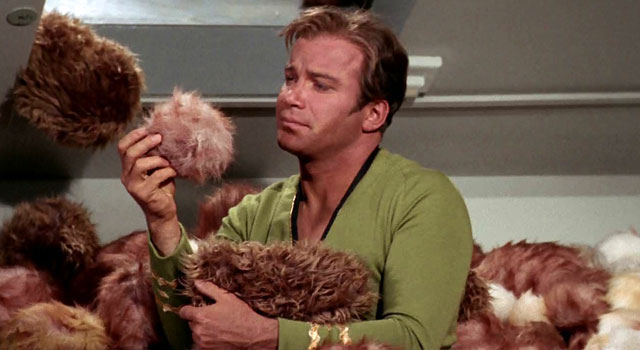
Tribbles Will Eat All Your Stuff. … and there goes the tea. Guess it’s just the phasers, then.

Tribbles Will Improve Your Battle Prowess. Carry tribbles, GET TUFF. Makes no sense, but it’s still funny to beam down an away team and have your Vulcan first officer start petting his tribble in the middle of a firefight.

“Petting His Tribble” is Not A Euphemism, It’s Just What Happens. Get your mind out of the gutter!

A Starbase Full of Ships Is Available to All… For the Right Price. Just a Lieutenant (Junior Grade)? No matter; open that wallet, pal, and you can own ALL the ships. The economics of the future ain’t that different after all.

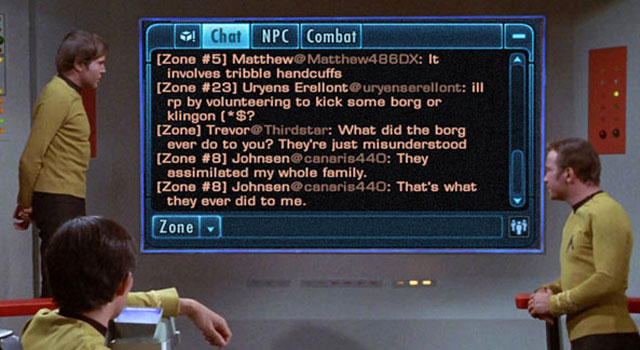
90% of the People Who Type in the Chat Window Think You’re a Moron. “Peace and understanding of that which is different” went out the door with that hippie Picard, n00b. Set phasers to NERD RAGE.

The Other 10% Do Not Speak English. Malfunctioning Universal Translator, perhaps? How did they finish the tutorial without reading any of it?

Seriously, if the battle at Wolf 359 had gone down like group assaults I’ve joined, the Borg would have assimilated half the Earth while everyone in space was still bickering. Imagine Riker on the Enterprise, hollering over the comm at everyone to STOP USING KINETIC WEAPONS YOU %#^#&^ING $%@#$s; half the fleet flying in circles not doing anything; a handful of Captains trying to calmly explain what to do while some random lieutenant named Corporal Giggles tells them he totally saw a video on subspace showing exactly what to do and you guys totally just have the wrong tribbles equipped; and two alien officers with their universal translators turned off just ramming the Borg cube, transporting out to different ships, and then ramming said cube again.

Before you ask in the comments: Yes. This game is FUN. Wait. Why am I still typing? I’ve got Duty Rosters to get back to!

Until next time!

“Federation Follies,” a humor column by Willie Laundrie II, looks at the lighter side of Star Trek.

Collector’s Corner: Looking Back at the 1982 Star Trek CEDs

Star Trek CED Cover

From 1981 until 1986, RCA marketed the precursor to the modern DVD known as the CED (Capacitance Electronic Discs) or VideoDiscs.

Star Trek episodes and films have always been a popular choice for new home entertainment formats, appearing as reel to reel films, BetaMax and VHS tapes, CD-ROMs, and DVDS among others. Star Trek‘s inclusion as one of the first CED titles back in the 1980s was a vote of confidence in the franchise by both RCA and Paramount.

A total of 11 Star Trek episodes and three movies, The Motion Picture, The Wrath of Khan and The Search for Spock, were available in this format during the five years that CEDs ruled home entertainment.

With this being the 45th anniversary of the first appearance of Khan Noonien Singh, we thought fellow fans would enjoy a nostalgic photo essay about the Trek CEDs.

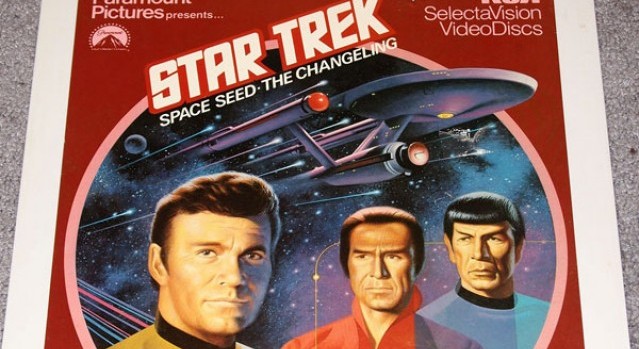
These are photos of the fourth Star Trek CED which was available starting November 1st, 1982. It contained the programs “Space Seed” and “The Changeling” and was advertised as featuring the episodes that inspired the first two movies.

The cover design is interesting, as it displays heroic images of Captain Kirk, Mr. Spock, and Khan, and its larger than LP packaging makes for great presentation.

Star Trek CED Back Cover

Star Trek CED Cover & Disc

Photos courtesy John Tenuto

Collector’s Corner: New Star Trek Kitchen Items from Westland Giftware

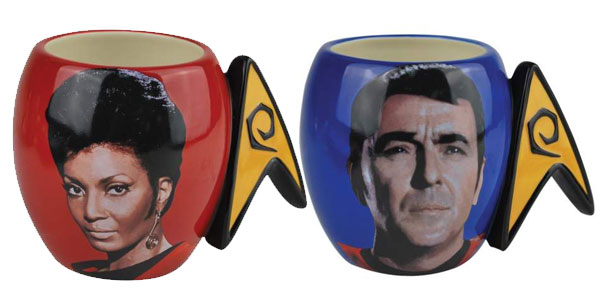
Uhura & Scotty Coffee Mugs

Westland Giftware continues its line of useable Star Trek items in 2012 with four new offerings.

The first is a 10” Captain Kirk Cookie Jar, a companion piece to the previous released Spock jar.

Captain Kirk Cookie Jar

Last year, Westland Giftware premiered three 4.5” coffee mugs with unique delta insignia handles of Kirk, Spock, and McCoy. Now, the line continues with Scotty and Uhura being added to the mix.

Uhura & Scotty Coffee Mugs

Finally, there will be a Delta Command Insignia Salt and Pepper Shaker. At 4.25”, the two shakers will join together via a magnet to create Starfleet’s most famous symbol.

Star Trek Salt & Pepper Shakers

All of these items are expected to be available during the first quarter of 2012.

Visit Westland Giftware for more information.

New Spock Statue Coming in 2012 from Hollywood Collectibles [Pics]

Spock statue

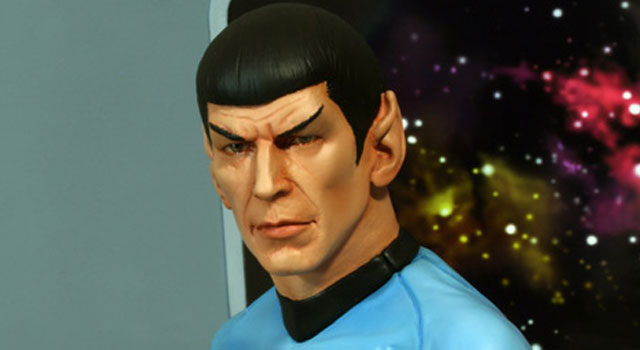
Some fascinating news for Star Trek collectors! The Hollywood Collectibles Group announced this week the third in its continuing line of Star Trek statues. The latest release, Mr. Spock, stands at 1/6th scale. Made of heavyweight polystone, this hand painted statue features a 12” tall Spock standing next to his console from the U.S.S. Enterprise.

Like the previously announced Captain James T. Kirk and Gorn 1/6th scale statues, the Mr. Spock version is offered in both regular and exclusive editions. 600 regular edition statues will be released for $199 and will be available from online retailers such as Entertainment Earth and Big Bad Toy Store.

The exclusive edition features an expanded science station console and is limited to 150 pieces. The retail price of the exclusive edition is the same at $199, however it is only available directly through Hollywood Collectibles Group.

Both editions are expected to ship during the second quarter of 2012.

For more information and additional photos, visit Hollywood Collectibles Group.

Spock Statue

Spock Statue

Spock Statue

Strangers of the Cosmos: Bolians

star-trek-bolians

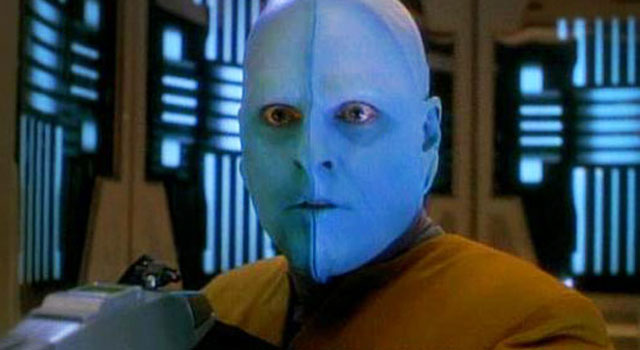
Bolians were primarily featured as minor characters in Deep Space Nine, The Next Generation, and Voyager. Their personae often ranged from cowardly to greedy, and their presence on the show seemed to serve the purpose of offsetting particular tones and moods. Well, the writers may not have done them much justice in the past, but in this installment of Strangers of the Cosmos, I plan to do just that: Give them the respect they deserve—or rather examine their biology a little further, which is more attention than they have gotten before.

Blue Blood and Blue Skin

Let’s start with the obvious details. One doesn’t need to be a biologist to figure out that they have blue skin. Like Andorians, Bolian blood is also blue. Assuming Bolians metabolize and transport oxygen the same way humans do (how else could they breathe in the same atmosphere as us), their oxygen-carrying proteins would utilize metal ions with an affinity to bind oxygen. In humans, hemoglobin uses iron(II) to bind oxygen; in fact, the red color in our blood comes from iron in its +2 oxidation state. In Bolians, the metal that binds oxygen is most likely copper(II) (again, in its +2 oxidation state). Copper(II) appears blue in solution, unlike most other transition metals with varying colors. Of course, skin color is independent of blood; the bluish tint in their skin is primarily due to pigments, the origins of which may be the result of natural selection for some unknown survival benefit. So remember: The color of blood-borne ions does not correlate with skin color; if it did, Vulcans would be green.

The Bolian “Flight or Flight” Mechanism

Don’t be confused by the subject title. I really meant “Flight or Flight” because Bolians seem to do a lot more running away than actual fighting on the show. In fact, Bolians were often presented as being overly cautious and paranoid on Star Trek. In the Deep Space Nine episode “The Adversary” (the season 3 finale) the Bolian security officer was always more jittery and paranoid about the Changeling imposter on the Defiant than everybody else. Though any person would be understandably paranoid if a potentially hostile Changeling was aboard a small ship, the Bolian remained more fearful and irrational than any other member on the Defiant.

Bolian Security Officer

In one scene, he almost shot Captain Sisko and Major Kira out of a sense of self-preservation and fear, as though his discipline as a Starfleet officer were somehow neglected. Another instance was on Empok Nor, where Nog, Miles O’Brien, Garak, and a team of ensigns visit DS9’s sister station to salvage technical parts and components.

When a group of drugged, psychotic Cardassians were let loose in the station to hunt down the intruders, it is the Bolian, among all the others, who prefers to hide rather than go after the assassins. In fact, the Bolian says he would feel a lot safer with Garak on the hunt for the two Cardassians, implying that he would rather have someone else do the fighting for him (and of course Garak was also a highly trained spy and assassin in the Obsidian Order, so that fact more than influenced the Bolian’s decision). Even when other Starfleet officers were willing and able to defend themselves, the Bolian insisted on hiding.

Bolian security officer aboard the USS Defiant; he nearly shoots Captain Sisko and refused to lower his weapon when ordered to do so by two superior officers.

It doesn’t mean Bolians would always run from a fight (they wouldn’t volunteer in Starfleet otherwise), but they seem to be more prone to fear than any other race on Star Trek. This “flight” instinct may have been a crucial part of their evolution. If they evolved on a planet where their species were constantly preyed upon and where a direct confrontation with predators would almost always lead to defeat (as implied on the Deep Space Nine episode “The Magnificent Ferengi” in which it is said that Bolians have always been physically weak), then natural selection would favor the fitness of individuals with a tendency to run and hide for self-preservation.

The fearful, cautious, even paranoid Bolians would naturally avoid danger and survive long enough to have a greater chance to pass on their traits to offspring, while brave Bolians who probably didn’t have the strength to overcome threats to individual survival would likely die out quickly. The early Bolians with the ability to hide better would persist, survive, and reproduce faster than those who chose to fight in unwinnable battles.

A race of cautious, paranoid individuals is the logical outcome of a form of natural selection that favors fear as a means of survival. As such, their natural instinct to hide or run from danger may have influenced their social behaviors, which would explain why they appear to be scared on the shows. Of course it’s difficult to prove that their concept of fear comes from this “flight” mechanism from the standpoint of only a few examples (and in science, it takes A LOT MORE than just two data points to confirm a hypothesis), but this is, after all, only harmless speculation.

The Hairless Phenotype and Reproduction

Members of the Bolian race tend to be completely bald, with the exception for the few females who had hair on The Next Generation. Assuming Bolian genetics is anything like human genetics and that they have gene-carrying chromosomes the same way we do, it can be inferred that the hair/bald phenotype is a sex-linked trait, meaning essentially that the expression of a given trait correlates with gender.

This is not to say, however, that the baldness trait in Bolians is anything like the baldness trait in humans (which is also a sex-linked trait), but rather that the expression of the hair trait may be activated by genes on one (or several) sex chromosome(s). It may be that the expression of the hair trait is activated by a combination of functional genes. If this were the case, then the actual gene that directly produces hair isn’t necessarily in females only; it could also be in men.

One of the abducting aliens on the TNG episode “Allegiance” who took on the appearance and role of a female Bolian with hair; though not actually a Bolian, it can be assumed that females with hair are not uncommon among Bolians as neither Picard nor anyone else found her appearance to be suspicious.

It is really impossible to determine whether the hair phenotype is located on the sex chromosome(s) in Bolians, but certainly the genes that activate hair production is likely located on the sex-chromosome. If anything can be inferred from Star Trek, it’s that Bolian hair could be an ethnic and/or “sexy” trait used as a means to attract the opposite gender, hence the reason why some Bolian females have beautiful, voluptuous hair. For the same reason that large breasts and hourglass hips in human women attract males to potential mothers (large breasts for maximum milk production and a wide pelvic bone to support fetal development), hair may be a sexual indicator of potential mothers in Bolian females. Therefore, the gene that produces hair may be present in all Bolian females but is only activated when a combination of factors are present, such as those that enhance fertility in women.

Mitena Haro

If this were the case, wouldn’t more females have hair because women with hair would probably reproduce and nurture their offspring better than bald women (and that males would prefer to mate with females with hair as opposed to unattractive, bald Bolians)? Instead, we’ve only seen one or two Bolian females on The Next Generation; all the rest were bald. It certainly may be the case that hair is not only a sexual indicator, but perhaps an ethnic trait as well. It’s possible that the Bolian species consists of many different ethnic groups from different regions on their home planet just like humans do. So hair may be apparent in certain ethnic groups where the association between hair and reproductivity was maintained by natural/sexual selection. If early Bolians migrated and diverged from this prime ethnic group and somehow lost that association (i.e. a new location means different selective pressures), then perhaps they also lost the “hair” gene. This would explain why so many Bolians, both male and female, are bald while only a few apparently still have hair.

Tom Caldwell holds a Bachelor’s of Science in biochemistry from UCLA. He is currently working towards a Ph.D. in molecular biology.

Celebrating 25 Years of Star Trek IV Collectibles + Behind-the-Scenes Footage

star-trek-iv-magazines

Star Trek IV: The Voyage Home celebrates its 25th anniversary today. Its premiere provided fans with many great collectibles. In celebration of Star Trek IV, TrekNews.net presents a look at some of the best collectibles from the film.

Interestingly, travelling back in time to learn about Star Trek IV merchandise, appropriate considering the motif of the movie itself, also provides a lesson in 1980s trends and zeitgeist.

From LPs to plastic cups, Star Trek IV collectibles represent both a science fiction future and a real past.

Star Trek IV Coca-Cola Cup

The Coca Cola Star Trek IV plastic cup was available at local theaters with a purchase of a soft drink.

The Star Trek IV soundtrack was available on CD, LP, or audio tape.

Star Trek IV Magazines & Comics

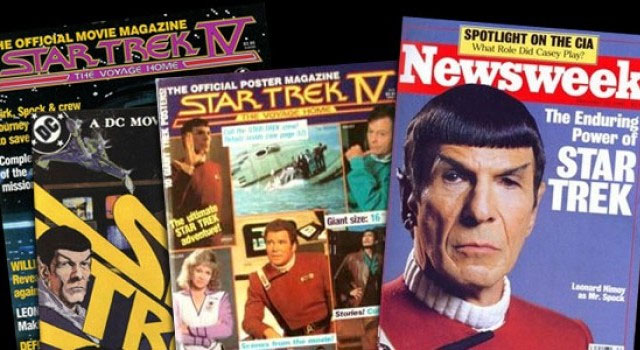
Starlog celebrated the premiere of The Voyage Home with publications such as The Official Movie Magazine and The Official Poster Magazine.

Speaking of magazines, Star Trek and Leonard Nimoy graced Newsweek in 1986.

DC Comics, then the licensee for Star Trek, provided fans with a comic book adaptation of the movie

Australian Trekkers had a very unusual movie poster that was also used in some other nations. Today, these are collector’s items worldwide.

Fantasy Trading Card Company offered a unique set of Star Trek IV trading cards which had no text on the front and featured a plain white border. Rittenhouse Archives, the modern Star Trek trading card licensee, has released Star Trek IV cards when featuring movie themed sets, including autographed cards of some of the stars.

Star Trek IV Soundtrack on LP
Star Trek IV Audiobook on LP

In an example of times gone by, films used to often have “books on tape” versions for younger fans. Star Trek IV had an edited version available on record and tape from Buena Vista.

Star Trek IV Plate from Hamilton Collectibles

The Star Trek IV plate was actually available as an item from The Hamilton Collection’s “The Movies” plates.

Spock & Kirk Star Trek IV figures
Spock & Kirk Star Trek IV figures from Diamond Select

Exemplifying the popularity of Star Trek IV, the movie finally got its first action figures in 2009 from Diamond Select Toys.

Other items from the last few years, including rare photos from WilliamShatner.com from Star Trek IV and film cells framed with a photo from Film Cells Ltd, have been available from Star Trek IV.

Many of the stars from the film attend conventions, such as Catherine Hicks. Fans are able to get autographs on Star Trek IV memorabilia and photos.

Star Trek IV 1976 Chevrolet Truck
1976 Chevrolet Truck used in the filming of Star Trek IV

And arguably the most unusual collectible, the Volo Museum in Illinois recently auctioned the 1976 Chevy truck from Star Trek IV used to ferry Admiral Kirk, Spock, Gillian Taylor, and a pizza in the film!

BONUS:

In 1985, my parents happened to be at the Monterey Bay Aquarium on a day Paramount was filming Star Trek IV. I was a student back then and did not go on that vacation with my parents. Knowing of my love of Star Trek, my father and mother spent their day at the aquarium filming actors for their son back home instead of enjoying their vacation. In a genuine expression of how times have changed, and because there was no Internet then as a source of video sharing, the film crew did not mind if people filmed the action. Here is some of the video that my parents filmed. You will hear my father’s voice as he excitedly tells me about the actors. Enjoy!

Science Fiction or Science Fact: NASA Developing Tractor Beams

NASA Tractor Beams

Back in August, I wrote a detailed scientific critique of one of Star Trek’s more elusive technological concepts: the tractor beam; the ability to tug objects using an electromagnetic field. Though I deemed the piece of technology as Science Fiction, a team of physicists and engineers at NASA’s Goddard Space Flight Center are planning and developing a laser that would act as a “tractor beam.” Not actually a tractor beam, this device uses electromagnetic wave fronts and directed photons to guide and pull tiny particles from a distance.

The mechanics behind the tractor beam are essentially the same as what was previously demonstrated with lasers. Scientists at the Australian National University were able to use a directed laser beam to carry microscopic glass particles midair across a distance of 5 feet. It works by shining a “hollow laser” at a target (i.e. tiny glass particles) such that the laser heats up a narrow band of air molecules surrounding the target but the interior of the laser (in direct path of the target) remains cooler. The particles would remain in the interior of the laser because the heated molecules surrounding it would exert a pressure against the target, so the particles could float effortlessly to or from the laser source.

Tractor Beam Optical Trapping

The only drawback with this technology is that it requires a gaseous medium (i.e. atmosphere); this means that it wouldn’t work in the vacuum of space. However, NASA scientists, Barry Coyle, Paul Stysley, and Demetrios Poulios may prove that a working tractor beam in space is not only possible, but may be more practical than conventional sample collection.

NASA Scientists
Goddard laser experts (from left to right) Barry Coyle, Paul Stysley, and Demetrios Poulios
Photo Credit: NASA’s Goddard Space Flight Center, Debora McCallum

The technique uses optical solenoid beams. When the laser is directed against tiny particles (i.e. dust), it propagates a force on the particles against the direction of the laser beam. It is not actually a tractor beam as one may see on Star Trek; it is more akin to pushing a floating ball in pool water: it generates enough momentum to move on its own. Like the floating ball analogy, this laser beam simply exerts a force on something to allow it to move on its own; it doesn’t pull or tug anything.

The good news is that the force exerted by this laser is independent of atmosphere, meaning that it can work in space. This holds great potential for space exploration! The best application for such a device would be to capture dust samples from a passing comet. Normally, we would fly a probe into a comet’s “tail” to pick up debris, but this is a very risky (and expensive) maneuver, especially since we have to do it “blindfolded.” But in the near future, we may use a laser beam to trap comet samples from a safe distance, and it would be of great benefit to science because analyzing its chemical composition alone would provide us with invaluable information regarding the formation of our solar system.

Unfortunately, this “tractor beam” can only be used for small-scale purposes, which limits the scope with which it can capture objects. The electromagnetic beam couldn’t possibly generate enough momentum to move particles larger than bits of rock, and even that would be hard enough. Well, guess that means we won’t be towing our shipment of grain to Sherman’s planet after all.

NASA has already demonstrated the potential of such laser beams in a laboratory setting, but they don’t plan on stopping there. They are currently working on new revolutionary techniques to optimize the tractor beam and make it more efficient, cost-effective, and practical to use.

For more information, visit NASA.

Merchandise News: Star Trek HeroClix + Mr. Potato Heads

star-trek-potato-heads

WizK!ds, the company that recently released the Star Trek: Fleet Captains and Star Trek: Encounter cooperative games, announced this week a new Star Trek HeroClix game called Star Trek: HeroClix: Tactics.

Players will either control Klingon or Federation starships during strategic battles and events that are compatible with the HeroClix core rule systems. Tactics includes more than 20 painted ships that are collected in the 4 ship starter set and as single figure boosters. Star Trek now joins such venerable franchises as DC Superheroes and Marvel Comics which have been popular HeroClix games for almost a decade.

The starter set will include 4 starships, 2 theme dice, a rulebook, a powers/ability card, and two full color maps and is available for order at gaming stores, comic shops, and online beginning in February 2012.

Kirk & Kor Potato Heads

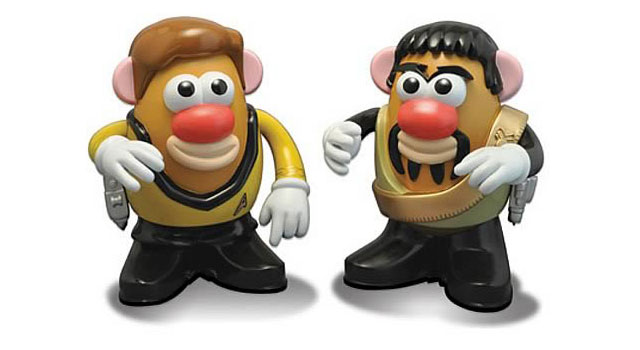
In other merchandise news, available this week at retailers is the PPW Toy company’s Captain Kirk/Kor Mr. Potato Head two pack. The two pack includes the traditional interchangeable clothes, faces, hair, and shoes, yet themed around Star Trek characters.

Those who purchased the Star Wars Mr. Potato Heads a few years ago may be surprised that Mr. Potato Heads have shrunk some in size and are appreciably smaller.

Spock & Uhura Potato Heads

Despite this scale change, there is much to like about these fun items. The packaging begins the fun with descriptions on the back proclaiming that Captain Kirk Mr. Potato Head includes his signature smirk and Kor’s intimidating facial gestures. Kor is especially nice, and while PPW could have taken shortcuts, they have paid attention to details with an example being the differing boots of the characters. A Spock and Uhura two-pack is available beginning this November to continue the fun.

To order Kirk and Kor or Spock and Uhura, visit Entertainment Earth.

Strangers of the Cosmos: Changelings

DS9's Odo

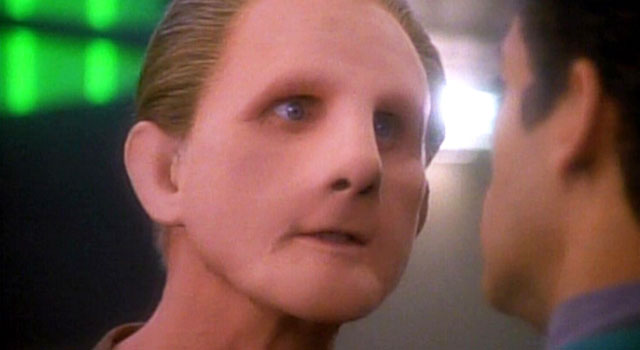
Changelings, also known as the Founders, play an important role in science fiction as deceivers and impersonators. On Star Trek: Deep Space Nine, they are the leaders of the dreaded Dominion, the vast empire that controlled the entire Gamma Quadrant and fought a violent three-year war with the Federation and the Klingon Empire. Their ability to change shape into any object and impersonate any member of society makes them one of the most feared races in the Star Trek Universe.

What physiological processes are involved in shape-shifting? The first thing that comes to mind is differentiation. Cell differentiation is a phenomenon of biology in which cells can replicate and branch out into new types of cells. This is displayed in the remarkable properties of pluripotent stem cells, which not only have the ability differentiate into any cell but they also generate “immortal” cell lines (see my previous Science Fiction or Science Fact article on regenerative medicine for more information). Changelings are probably nothing more than a sophisticated collection of stem cells that forms an even larger network, all communicating and adapting together, generating some form of collective intelligence or self-awareness (i.e. the Great Link).

The Great Link
The Great Link on the Founders’ homeworld

Of course, stem cells really don’t differentiate overnight. It can take several months of rigorous lab work to generate one stem cell line and differentiate it into something new. Furthermore, there are no instances of stem cells differentiating into cells of another species; the ability of Changelings to quickly shape-shift into a Romulan or a human cannot be explained by our current knowledge of stem cell biology, but rather by some other unknown biological process (which may be impossible, in my opinion).

Perhaps the most disturbing notion about Changelings is that the very nature of shape-shifting seems to breach the universal Law of the Conservation of Mass. Mass can neither be destroyed nor created (at least in conventional physics). In accordance to the law, the mass of a Changeling does not change when shape-shifting. Essentially, the bird-form of a shape-shifter would have about as much mass as a 200-pound person. That’s way too heavy for a shape-shifter to fly on Earth!

This always disturbed me because Changelings on the show seem to transform into objects that were easily carried around by individuals without significant exertion. Consider the scene in the DS9 episode, “Homefront”, where Captain Sisko and Vice Admiral Layton walk in with a seemingly light briefcase which turned out to be the shape-shifted form of Odo. How can all the mass of one person be so condensed into the size of a briefcase and not feel quite as heavily? Sisko should’ve been dragging Odo on the ground, using all of his strength and weight to pull him!

Changelings are gelatinous in their native form. Every 16 hours they must revert to this state in order to regenerate from a day’s worth of shape-shifting. This implies, as it should be obvious, that morphing into and maintaining different structures require metabolic energy, and reverting to their gelatinous state “saves” energy.

Odo unable to hold his shape
Odo’s cellular structure destabilizes and turns gelatinous when unable to maintain his form

We still have yet to see a Changeling eat and metabolize food. No organism, no matter what species it is, can survive without sustenance; it is a foundational principle of cell biology. Where and how do the Founders get the energy to survive, let alone shape-shift? They certainly don’t get it while sleeping because sleep does not recuperate energy; it still consumes it, albeit at a lower rate. If rapidly differentiating and mass-altering stem cells don’t bother you, then an organism that can survive without food should! Obviously, they must get it somewhere and somehow.

Other aliens of Star Trek may seem unlikely in terms of biology, but Changelings are certainly one of the least plausible (and most bizarre) races described in the canon. If you can imagine a species that exists as a huge mass of extra-potent, immortal stem cells that can instantly change its own shape and mass and thrive on no metabolism, then you have yourself a Founder! One thing is for certain: there is nothing in conventional biology that could help us rationalize the way Changelings are put together, so I leave it to our greater imagination to find the answers.

 
Tom Caldwell holds a Bachelor’s of Science in biochemistry from UCLA. He is currently working towards a Ph.D. in molecular biology.

Federation Follies: Trek-Or-Treat!

star-trek-pumpkin

The weather is getting chillier, autumn is coming to a close, and the darkness seems to chase the daylight away a little bit sooner each night. Truly, the most chilling season of the year is upon us and the signs are everywhere: Sounds in the night suddenly seem more foreboding. Plastic tombstones and artificial dead people on the neighbor’s lawn. Discount candy & thrashed “Sexy” Spongebob costumes litter the floor of your local department store (probably by the recently displayed Christmas merchandise).

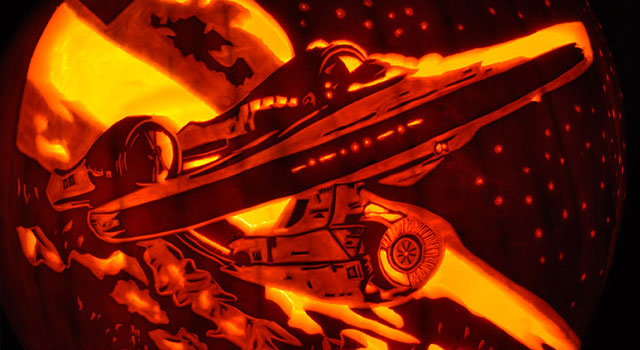
I think there’s probably a new Saw movie out or something. Whatever. It’s Halloween! And what better way to spend this weekend waiting for the big day (and candy-filled night) than to scare yourself silly with Star Trek? Follow me now, dear viewer, as we gaze upon the darker side of Trek:

“Wolf in the Fold” (Star Trek: The Original Series, Season 2)
Murder! Mayhem! Belly dancers! Is the chief engineer of the Enterprise going insane, blacking out and murdering the locals while on shore leave? Or is something far more sinister at work? You only get one guess, and if you’re wrong, I slap you.

“Night Terrors” (Star Trek: The Next Generation, Season 4)
This episode is what first got me thinking about a list like this. Although nothing supernatural occurs during the episode, there is some fairly disturbing imagery (especially a scene with Dr. Crusher “alone” in a cargo bay).

“Empok Nor” (Star Trek: Deep Space Nine, Season 5)
A different kind of terror, this episode has more in common with “Predator” than “Poltergeist.” As Chief O’Brien, Nog, Garak, and a handful of expendable newcomers search an abandoned (and poorly lit) Cardassian station for spare parts, they find themselves stalked by unseen forces… and possibly betrayed by one of their own. Also, the way the station is hanging crooked IN SPACE, where there is NO UP OR DOWN, is pretty darn creepy.

“The Thaw” (Star Trek: Voyager, Season 2)
If The Joker has taught me anything, it’s that clowns can be pretty terrifying… and a clown created as the physical manifestation of five people’s fears would be downright horrific. If watching Kim and Torres try to escape his carnival of horrors gets too frightening, just tell yourself that the clown is really Lenny from Laverne & Shirley. See if it helps.

“Eye of the Beholder” (Star Trek: The Next Generation, Season 7)
This one makes the list because “Geordi and Data remove a skeleton” is literally part of the plot synopsis on Memory Alpha. There’s suicide, murder, psychic vibrations that travel across time to torment the ship’s counselor… plus, Geordi and Data remove a skeleton. SPOOKY. For more murderous fun, see “The Meld” (ST: Voyager, Season 2).

“The Xindi” (Star Trek: Enterprise, Season 3)
Seriously, this whole season was basically Star Wars: Episode II: Attack of the Clones. More than anything on this list, THAT is truly chilling.

There are plenty more great ones (The salt vampire of M-113 in “The Man Trap” and Picard vs. Ardra in “Devil’s Due” strike me as appropriate). Feel free to leave any I missed in the comments, and have a Happy (and safe!) Halloween!
“Federation Follies” is a weekly humor column by Willie Laundrie II, taking a look at the lighter side of Star Trek.

New Light-Up Star Trek Enterprise Feeding Set for Babies

enterprise-feeding-set

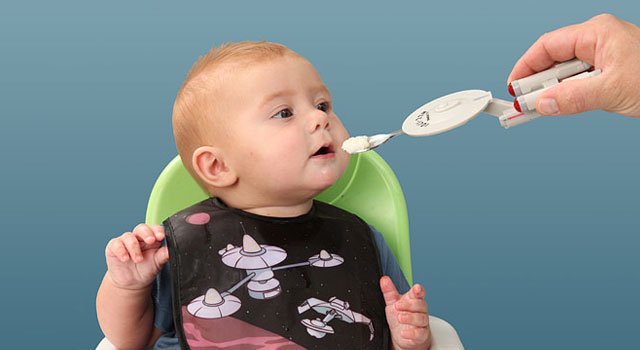
“Blah! Blah! Blah!” The children of Miri’s planet rejoice! Think Geek has a brand new Star Trek Enterprise Light Up Feeding System for infants aged 12 months and older. Priced at $24.99, the system includes both a light up bib featuring an animation styled Deep Space Station K7 and Klingon battle cruiser and a light up 8.5” long and 3” wide USS Enterprise with detachable spoons.

The futuristic set helps bring the “airplane is coming in for a landing” feeding strategy into the 23rd century. Think Geek is continuing their line of usable “collect-edibles” type of products, with previous items including Star Trek themed “sporks” and the awesome Enterprise shaped pizza cutter.

For parents who wish to raise their children properly, meaning as Star Trek fans, they could check out the feeding system in action with this video from Think Geek.

For more information, check out the Think Geek website

Star Trek Baby Feeding Set

Specifications from Think Geek:

• For ages 12 months and older
• Feed your baby in Star Trek style with this bib & spoon set
• Keeps baby’s attention and makes mealtime more fun
• LED lights in bib are motion activated
• Enterprise has on on/off switch
• Spoon modeled after the USS Enterprise NCC-1701
• Comes with three spoon attachments
• Spoon attachments are dishwasher safe
• Bib and plane washable with a damp cloth
• Button cell batteries required are included
• Batteries are replaceable in plane but not replaceable in bib
• Bib Dimensions: 7.5″ at widest point x 12″ tall
• Enterprise Spoon Dimensions: 8.5″ long (with spoon attached) x 3″ wide (saucer of Enterprise)
• Officially licensed Star Trek collectible
• Meets ASTM & CPSC regulations